Judgment
KEEPING STILL. Keeping his back still So that he no longer feels his body. He goes into his courtyard And does not see his people. No blame.
Image
Mountains standing close together: The image of KEEPING STILL. Thus the superior man Does not permit his thoughts to go beyond his situation.
Animated film sequence
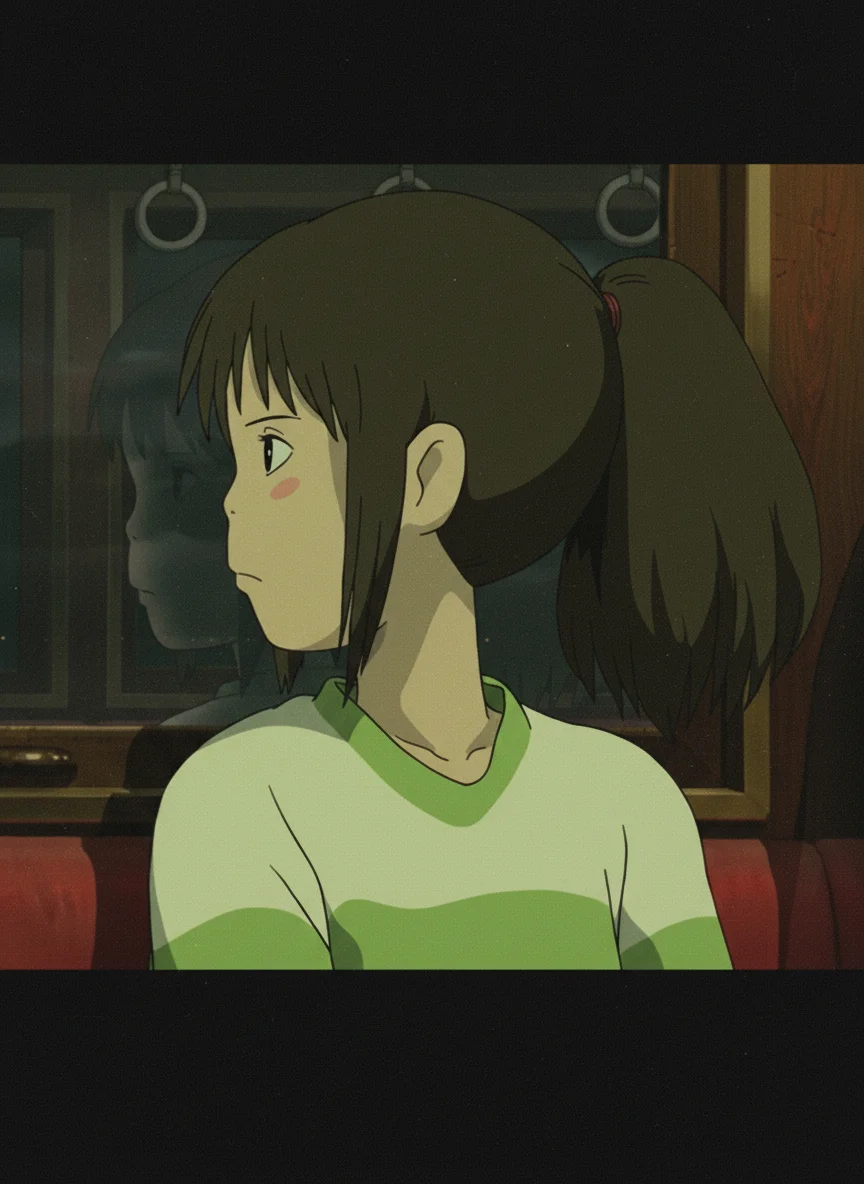
Spirited Away – The Flooded Train
Hayao Miyazaki / Studio Ghibli (AD 2001)
Here's what Miyazaki understood that most animators miss: stillness isn't the absence of motion. It's motion that's achieved perfect interior balance. The flooded train sequence—an extended passage of near-silence—gives you uninterrupted minutes to sit with Chihiro in the exact moment childhood ends. Not dramatically. Not with symbolic chrysalis-breaking. Just sitting. Watching waterlogged telephone poles slide past like grave markers. Shadow passengers translucent and silent. Water sloshing gently with the train's rhythm. Joe Hisaishi's minimal piano repeating like a meditation timer. The genius move: He doesn't freeze the action. The train moves. The water moves. The poles pass. But Chihiro—turned sideways to the window, face reflecting in blue glass—achieves something rarer than any magical transformation in the previous ninety minutes. She finds the interior steadiness that lets you be fully present in transition without grasping at either shore. Mountain over Mountain. ☶☶. The hexagram that shows up when motion and stillness aren't opposites but the same gesture viewed from different angles. When sitting still in a moving train becomes the most profound action available. Both Miyazaki and Wong Kar-Wai understood: the most important moments happen in vehicles between destinations, when you're neither where you were nor where you're going, just suspended in the journey itself.
Historical Context
- Period
- Zhou Dynasty
- Oracle Bone Etymology
- The character 艮 (gèn) in oracle bone script depicted a person turning to look backward—an eye gazing over the shoulder, suggesting stillness through self-awareness and introspection.
- Traditional Use
- Keeping Still (艮 gèn) represents the mountain: stability, meditation, boundaries. In divination, it counsels finding the interior point of stillness even amid external motion—not freezing action, but achieving centered presence that allows wise inaction or deliberate pause.
- Character Analysis
- Mountain over Mountain. The hexagram of doubled stability. When both trigrams are Mountain (☶☶), the teaching intensifies: true stillness isn't rigidity but the mountain's quality of remaining centered while seasons change around it. Miyazaki's flooded train sequence embodies this perfectly—motion continues (train, water, poles passing) while Chihiro finds interior mountain-stillness.
- Energy State
- Stillness doubled, meditation, interior centering. Yin containing yang, movement held in perfect balance.
- Trigram Symbolism
- ☶ Mountain (Upper) - Keeping Still, Meditation, Youngest Son, Earth ☶ Mountain (Lower) - Keeping Still, Meditation, Youngest Son, Earth Mountain over Mountain: stillness so complete it becomes the foundation for transformation. The superior man does not permit his thoughts to go beyond his situation—fully present, not grasping.
Sources
Lines
Line 1: 艮其趾無咎利永貞
Line 2: 艮其腓不拯其隨其心不快
Line 3: 艮其限列其夤厲薰心
Line 4: 艮其身無咎
Line 5: 艮其輔言有序悔亡
Line 6: 敦艮吉
Practical Guidance
Transformations
When changing lines appear in a reading, this hexagram can transform into another.
Get an interactive reading with this hexagram
Try the Oracle →