Judgment
Revolution. On your own day you are believed. Supreme success, furthering through perseverance. Remorse disappears. Revolutionary change must be undertaken at the right moment—not too early, when the old still functions, and not too late, when decay has set in. Bowie's timing was precise: 1972, when the counterculture had exhausted itself but no new form had crystallized. Ziggy arrived exactly when the culture needed permission to molt. The judgment says 'on your own day you are believed'—meaning the revolution succeeds not through argument but through demonstration. Bowie didn't convince anyone that identity was moltable; he showed them by doing it. Supreme success comes not from overthrowing the old, but from making the new so vivid that the old becomes irrelevant.
Image
Fire in the lake: the image of Revolution. Thus the superior man sets the calendar in order and makes the seasons clear. Fire in the lake creates steam—the visible sign of transformation. The image instructs: make time itself visible, clarify the seasons of change. Bowie's genius was making transformation theatrical, turning the internal molting into public spectacle so others could recognize their own season of change. The superior man doesn't hide the revolution; he performs it clearly so others can read the signs. Ziggy on stage was the calendar made visible: this is the season of molting, this is the day you can become something else. The clarity of the performance—the makeup, the costume, the alien narrative—made the abstract concept of identity-transformation into something concrete enough to imitate.
Cultural Artifact
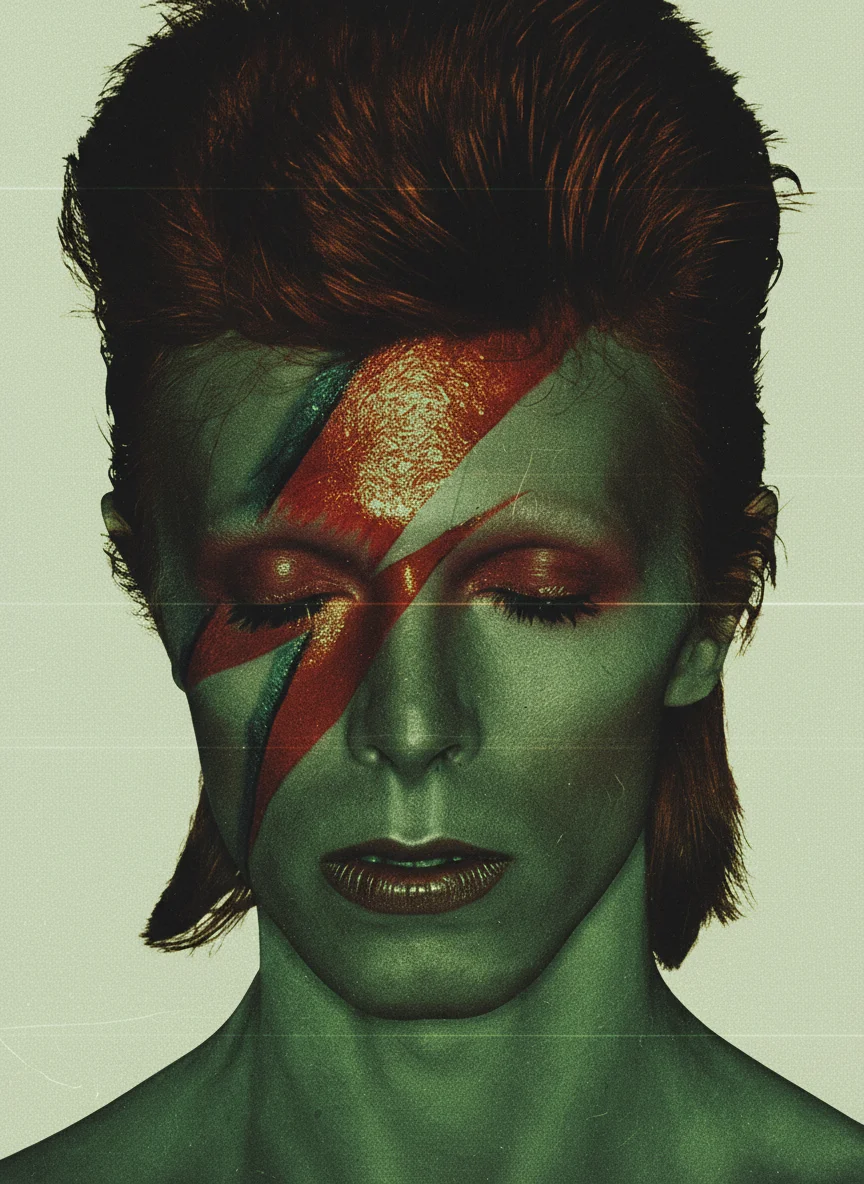
Ziggy Stardust
David Bowie (AD 1972)
July 1972. David Bowie steps onto the stage at London's Toby Jug pub—not as himself, but as Ziggy Stardust, an alien rock star from a dying planet. Red mullet. Lightning bolt across the face. Platform boots. The crowd doesn't know what they're witnessing yet: not a costume, but a passphrase. "You can become something else." Not metaphorically. Actually. The performance isn't theater—it's a transmission. Within months, teenagers across Britain are shedding their birth identities like snakeskin. Bowie didn't advocate for change; he demonstrated that selfhood is moltable, that identity can be donned and discarded like stage clothes. The revolution wasn't in the streets. It was in the mirror. Fire over Lake (☲☱): heat transforms water into steam, the old element ascending as something new. Revolution (革) in the I-Ching doesn't mean overthrow—it means molting. The snake doesn't destroy its old skin through violence; it outgrows it lawfully, inevitably. Ziggy Stardust was Bowie's molting, and in performing it publicly, he made molting available to everyone watching. Not permission granted by authority, but permission demonstrated by example. The image says: "When the vessel is empty, revolution is justified." Bowie emptied himself of David Jones and filled the space with Ziggy. The old self didn't die. It simply became obsolete.
Historical Context
- Period
- Zhou Dynasty
- Oracle Bone Etymology
- In the Zhou Dynasty, 革 (gé) originally depicted animal hide being tanned—the transformation of dead skin into something useful and new. The oracle bone form shows the hide stretched between poles, changing state. Fire over Lake: the trigrams show transformation through elemental conflict. Fire heats water until it must change form. Revolution occurs not through destruction but through reaching the point where the old vessel can no longer contain what's inside.
- Traditional Use
- 革 was consulted when the old order had exhausted itself—not through corruption, but through completion. Dynastic change, personal transformation, the moment when continuation becomes impossible and molting becomes necessary. The character's meaning evolved from 'tanned hide' to 'revolution' because both involve the same process: taking what was and making it into what must be.
- Character Analysis
- 革 combines 革 (leather/hide) with the radical for 'self' (己). The etymology is explicit: revolution is the self shedding its skin. Not the destruction of identity, but its transformation. Fire (離) above Lake (兌): joy beneath, clarity above. The revolution isn't grim—it's the relief of finally becoming what you've always been beneath the old skin.
- Energy State
- Lake over Fire creates steam—transformation through elemental conflict. Water heated until it must change state. The old form becomes untenable; the new form emerges not through force but through natural law. Revolutionary change that feels inevitable in retrospect.
- Trigram Symbolism
- ☱ Lake (兌 Duì): Joy, openness, what is expressed ☲ Fire (離 Lí): Clarity, illumination, what is seen Lake above Fire: the performance illuminates what was always hidden beneath the surface. Joy (Lake) rises as steam (Fire's transformation of water). The revolution is joyful because it's the relief of finally becoming visible.
Sources
Lines
Line 1: 鞏用黃牛之革
Line 2: 巳日乃革之征吉無咎
Line 3: 征凶貞厲革言三就有孚
Line 4: 悔亡有孚改命吉
Line 5: 大人虎變未占有孚
Line 6: 君子豹變小人革面征凶居貞吉
Practical Guidance
Transformations
When changing lines appear in a reading, this hexagram can transform into another.
Get an interactive reading with this hexagram
Try the Oracle →