Hexagram 48:

jǐng the well, wellspring, spring; resource-ful

By Augustin Chan · Last updated 2025

Upper TrigramWater
Lower TrigramWind

Judgment

jǐngthe well, wellspring, spring; resource-ful
gǎito change, alter, rearrange, reorganize
the town, village, settlement, community
is not; does, will not; without; rather than
gǎito change, alter; rearrange, reorganize
jǐngthe well, wellspring, spring, source
neither; regardless of; without; neither
sànglosing; loss; foregone; lost
nor; regardless of; or; nor
gaining; gain; secured; found
wǎngin, whether going; leaving; departing
láior coming; arriving; approaching
jǐngthe well
jǐngis the well
to almost, nearly, just about to, be about to
zhìreach, arrive, attain, succeed, consummate
and but then; and yet
wèito fall, come up short in, with
rope; the rope
jǐngthe well('s); of the well
léior to break, damage, ruin; entangle, upset
its, the, that
píngbucket, jug, jar, pitcher is; could, would be
xiōngunfortunate, disappointing, unlucky, sad

The Well. You can change the village but not the well. It neither decreases nor increases. They come and go and draw from the well. If the rope doesn't reach the water, or the jug breaks, misfortune.

Image

the wood
shàngover, above, on top of
yǒuis, there is
shuǐthe water
jǐngthe well
jūnnoble, worthy, honored
young one, heir, disciple
accordingly, therefore, thus
láoworks, labors, toils for, so that
mínthe people, others, multitude, humanity
quànto encourage; urging, encouraging
xiāngeach other; reciprocity, cooperation

Water over wood: the image of the Well. The superior man encourages people in their work and teaches them how to help each other.

Information Theorem
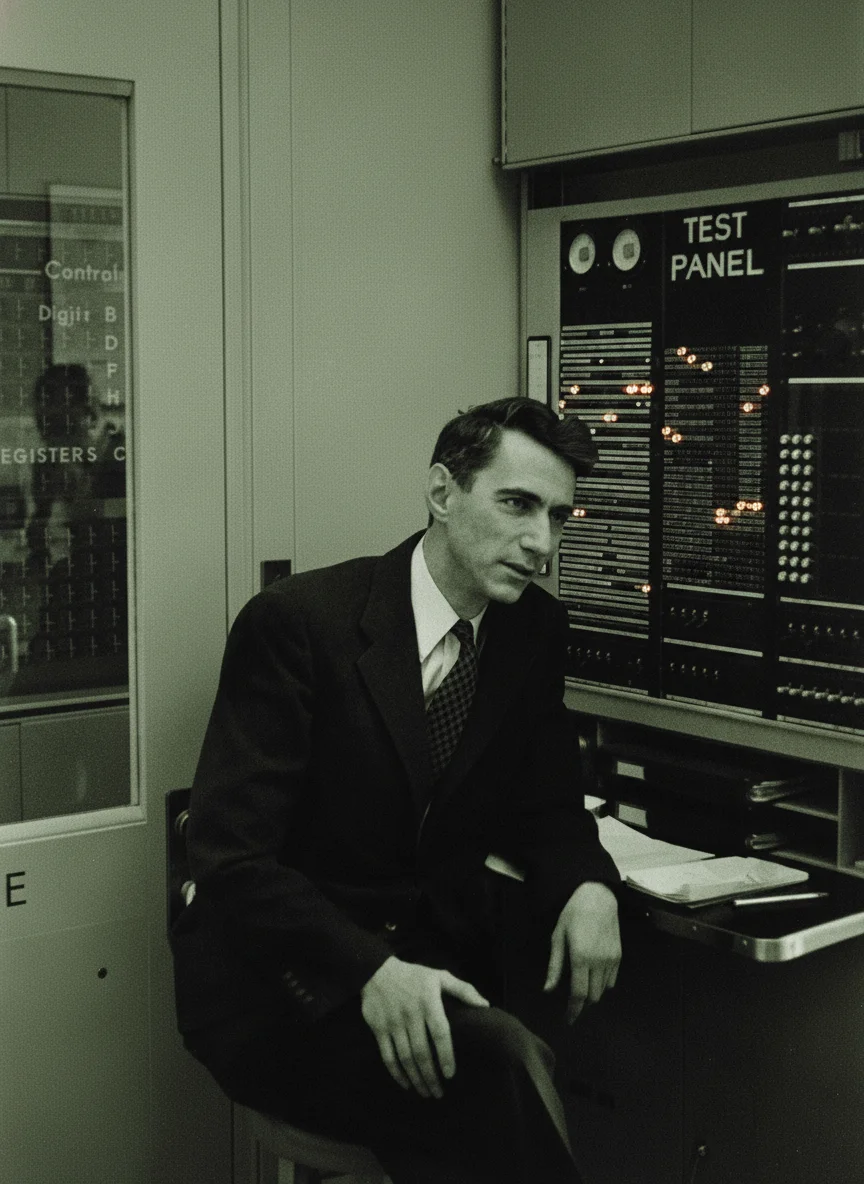
Hexagram 48 digital artifact

Claude Shannon - A Mathematical Theory of Communication

Claude Shannon (1948)

In July 1948, Claude Shannon published 'A Mathematical Theory of Communication' in the Bell System Technical Journal, creating information theory and defining the digital age. Before Shannon, 'information' was vague—news, knowledge, meaning. After Shannon, information became measurable in bits. His key insight: separate message from meaning. Information isn't what's said but what could be said. A message carries information proportional to its surprise—complete certainty carries none. Shannon quantified this with entropy: H = -Σ p(x)log₂p(x), measuring degrees of freedom, possible states, the space of what-could-be. From this foundation came compression algorithms, error correction, channel capacity, the bit itself. Hexagram 48 is The Well (井)—water over wood, the inexhaustible source communities draw from without depletion. Shannon created the well the digital world draws from daily: mathematical proof that you can communicate perfectly through imperfect channels by adding right redundancy. Seventy-seven years later, every protocol designer returns to the same source. The well doesn't run dry.

Historical Context

Period
Zhou Dynasty
Oracle Bone Etymology
Water (☵) sits above, Wood (☴) sits below—water drawn up from wooden well.
Traditional Use
The well is the village's inexhaustible source. Dynasties change, villages move, but the well remains. It nourishes everyone who draws from it without being depleted. The classical teaching: maintain the well, keep it clear, and it serves indefinitely.
Character Analysis
The character 井 (jǐng) depicts a well—the framework, the walls, the opening. The well's structure makes the water accessible. Without the well-frame, the underground water remains out of reach. This is the principle: the source exists, but useful access requires careful construction.
Energy State
Wood growing upward into water—water drawn from depth to surface. The well structure brings the source to those who need it. Yang in the center of the upper trigram shows the true nourishment available.
Trigram Symbolism
☵ Water (Upper) - Depth, source, nourishment ☴ Wood (Lower) - Growth, penetration, upward movement Wood rises to meet water descending—the well's function realized.

Sources

Lines

Line 1: 井泥不食舊井無禽

jǐngthe well('s)
mud
is not
shíconsumed
jiùthe old
jǐngwell
with
qínto hunt for

Line 2: 井谷射鮒甕敝漏

jǐngthe well
is empty
shèaim
the fish
wèngits earthen bucket
is cracked
lòuand leaking

Line 3: 井渫不食為我心惻可用汲王明並受其福

jǐngthe well is
xièturbid
but nothing
shíis consumed
wéimaking
our
xīnheart(s)
sad
it is suitable
yòngto use
and to draw
wángwere the sovereign
míngmade clear
bìngall
shòureceive
in
enrichment

Line 4: 井甃無咎

jǐngthe well is being
zhòure- lined
no
jiùblame

Line 5: 井洌寒泉食

jǐngthe well
lièis
háncold
quánspring
shíto drink

Line 6: 井收勿幕有孚元吉

jǐngas
shōucomes in
do not
cover
yǒubeing
true
yuánis most
promising

Practical Guidance

Engineering organizations can't keep redefining foundations. Teams change, products evolve, stacks shift—but you need stable abstractions everyone relies on. The well principle: build the source right once, let everyone draw indefinitely. Shannon's information theory is the platonic ideal. Seventy-five years later, every compression codec, error-correction scheme, channel capacity calculation draws from those 1948 equations. No bugs in Shannon's math. The well was built right. In your codebase, the well is your foundational library. Core abstractions that don't thrash quarterly. When designing these layers, you're digging a well your team will draw from daily. The text warns: if the rope doesn't reach the water, misfortune. Beautiful abstractions that are too hard to access fail. Shannon made theorems usable—elegant equations, clear notation, practical examples. Interface matters as much as depth. If the jug breaks, misfortune. When foundational layers fail (broken error-handling, violated API contracts, memory leaks), everyone depending on them fails. Integrity isn't optional. You can change the village but not the well. Products pivot, teams reorganize, companies get acquired. But core protocols, fundamental data structures, essential algorithms—these stay stable. Shannon published in 1948; telecom engineers in 2025 still reference the same theorems. What people miss: the well isn't static, it's maintained. Shannon's framework is stable, but implementations improve (LDPC codes, turbo codes, modern compression—all within Shannon's bounds). Your core library should be stable, not frozen. Bug fixes and better interfaces are valid. Essential abstractions shouldn't thrash. Identify what in your system should be a well. What abstraction is fundamental enough to remain stable while everything else changes? What's your Shannon entropy formula—the core insight everyone will reference for the next decade? Build that layer with Shannon's care. Make it correct, accessible, inexhaustible. Let your team draw from it daily without worry. The well serves because it's reliably there.

Transformations

When changing lines appear in a reading, this hexagram can transform into another.

Get an interactive reading with this hexagram

Try the Oracle →