Hexagram 46:

shēng advancement, ascent, step, climb upwards

By Augustin Chan · Last updated 2025

Upper TrigramEarth
Lower TrigramWind

Judgment

shēngadvancement, ascent, step, climb upwards
yuánfirst-rate, supreme, excellent
hēngfulfillment, satisfaction, success
yònguseful, practical, productive
jiànto see, encounter, meet with, consult
mature, complete, realized, great
rénhuman being, character, one, person, man
do not, don't
worry, suffer; be anxious, concerned
nánsouth, southern, southerly
zhēngexpedition; to advance, go boldly forward
promising, auspicious, opportune, timely

Pushing Upward has supreme success. One must see the great man. Fear not. Departure toward the south brings good fortune. Success through natural development and seeking wise guidance.

Image

earth, land, ground
zhōngwithin, inside, amidst, in the midst of
shēnggrows, develops, lives
wood, tree
shēngadvancement
jūnnoble, worthy, honored
young one, heir, disciple
accordingly, therefore, thus
shùnaccepting, compliant, agreeable, patient
character, temperament, nature, spirit
add, build up; accumulate, collect
xiǎolittle, minor, ordinary, small things
into; to make, reach; as a way, means to
gāothe high, eminent, prominent; nobility
full, important; greatness, maturity

Within the earth, wood grows: the image of Pushing Upward. Thus the superior man of devoted character heaps up small things in order to achieve something high and great.

Digital Artifact
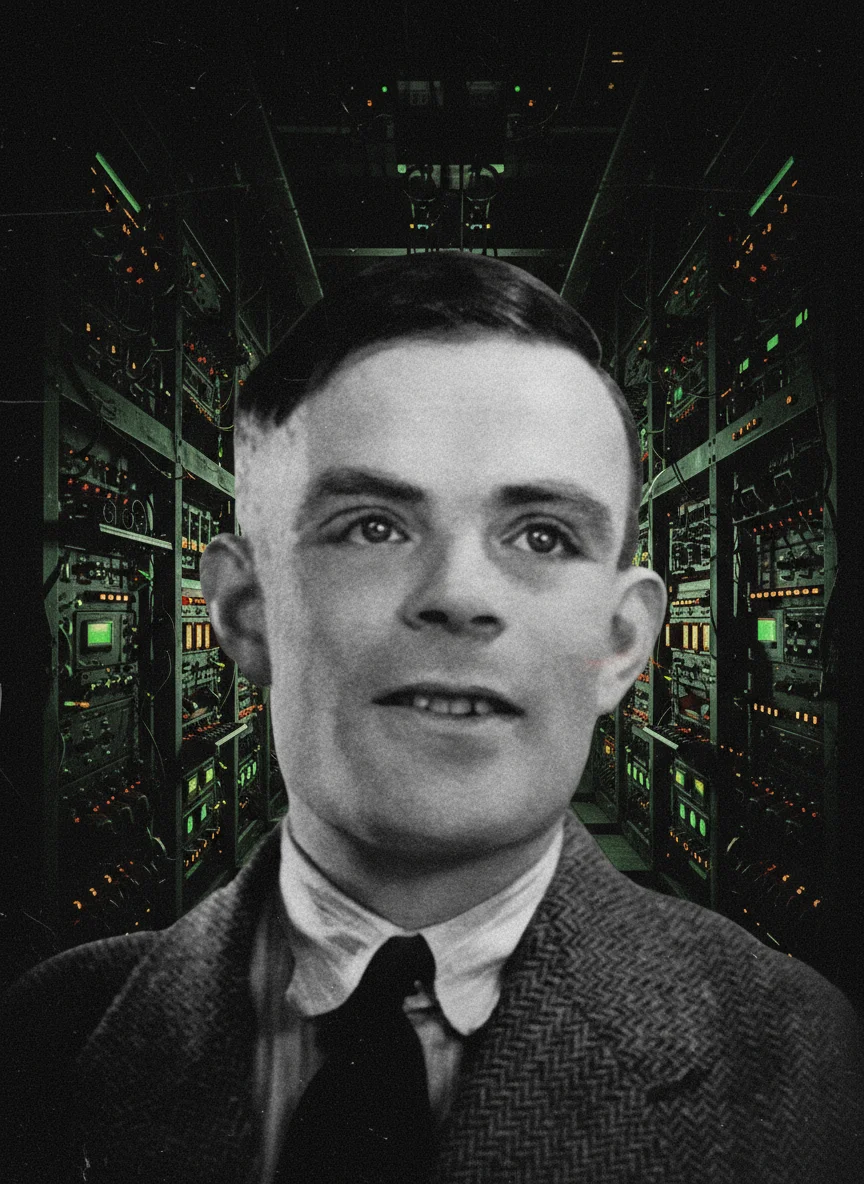
Hexagram 46 digital artifact

Alan Turing - On Computable Numbers, with an Application to the Entscheidungsproblem

Alan Turing (1936)

In 1936, at age 24, Alan Turing published his solution to Hilbert's Entscheidungsproblem: is there an algorithm to determine whether any mathematical statement is provable? Turing's answer came through invention—he defined what 'algorithm' means by imagining a theoretical machine. An infinite tape divided into cells, a read/write head that moves left or right, a finite set of states determining behavior. This 'automatic machine' could simulate any mechanical computation. Then the breakthrough: he described a Universal Computing Machine that could simulate any other Turing machine by reading its description from the tape. Every computer you've ever used implements this 1936 thought experiment. Hexagram 46 (Pushing Upward) describes effortless ascent—wood growing within earth, gradual but unstoppable advancement. Turing pushed upward from pure mathematics to define computation itself. Not building hardware—theorizing the abstract foundation that all future hardware would implement. The theoretical machine became universal truth: if a process is computable, a Turing machine can compute it. Sixty years before smartphones, he'd already defined their fundamental limits.

Historical Context

Period
Zhou Dynasty
Oracle Bone Etymology
Earth (☷) above, Wood (☴) below—wood growing upward through earth, natural effortless ascent, pushing toward light.
Traditional Use
The classical text describes pushing upward, organic growth from below, rising through receptive yielding rather than forceful assertion. The plant grows through earth without resistance. Progress happens naturally when conditions are right.

Lines

Line 1: 允升大吉

yǔnwelcome, allowed, granted, well-favored
shēngadvance, ascent, promotion; to step up
much, great, full of, a lot of; very
promise, hope, opportunity; promising

Line 2: 孚乃利用禴

sincerity; confidence, trust, assurance
nǎiis, comes before, precedes; first, and then
the real worth, merit, reward, gain
yòngin, when offering, presenting, dedicating
yuèthe modest, sparing spring sacrifice

Line 3: 升虛邑

shēngadvancing on, upon; acquiring
empty, unoccupied, vacant, ghost-
town, village, settlement, district

Line 4: 王用亨于岐山吉無咎

wángthe sovereign, king, ruler
yòngwill make, present, offer, perform
hēngoffering(s), sacrifice(s) (of xiang)
to, by, on, at, beside
Split, Forked, Twin; Qi
shānMountain; Mount
promising, auspicious, opportune, timely
not(hing) (is); no harm; no wrong
jiùwrong; making a mistake(s); doing wrong

Line 5: 貞吉升階

zhēnpersistence, determination, resolve, focus
promising, auspicious, opportune, timely
shēngthe advance; move up, ascend, climb
jiēby in steps, degrees, grades, stages

Line 6: 冥升利于不息之貞

míngthe blind, dark, obscure, dim
shēngadvance, ascent, climb
worthwhile; advantage, profit, reward
to; in, by, when, through
not being; avoiding, doing without
laxity; relax(ed, ing, ation); quit, rest
zhīin, about one's, such, this, that
zhēnpersistence, determination, resolve, focus

Practical Guidance

You're solving a specific problem—optimizing this API, fixing this bug, shipping this feature. The question is whether you're pushing upward or just moving laterally. Whether your solution builds foundation that enables future growth, or just patches today's issue. Turing in 1936 faced Hilbert's Entscheidungsproblem: is there an algorithm to determine if mathematical statements are provable? He could have answered narrowly—yes or no for specific cases, examples demonstrating limits. Instead, he pushed upward to the foundation: what does 'algorithm' mean? What defines mechanical computation? The Universal Machine emerged: theoretical abstraction that would eventually become every computer ever built. Not because Turing was trying to invent computers—he was doing pure mathematics. But by pushing to the deepest layer, by heaping up small theoretical things (tape cells, state transitions, read/write operations) into rigorous foundation, he defined computation itself. Hexagram 46: wood growing within earth. The plant doesn't force its way up through violence. It grows persistently from solid roots, and earth yields to that organic pressure. Turing's theoretical work pushed upward naturally—the math was so fundamental that hardware eventually had to implement it. Von Neumann architecture, every CPU since, your phone, the cloud—all Turing machines. Here's what most engineers miss: lateral movement feels productive. Shipping features, meeting deadlines, solving immediate problems. But you're not building foundation—you're accumulating technical debt and complexity. Real advancement comes from pushing downward first, then upward. Getting to bedrock principles, then building abstractions that make everything above them simpler. The classical text: heaps up small things to achieve something high and great. Turing heaped up: definition of computation, proof of universality, analysis of decidability, formalization of effective procedures. Small mathematical things. They grew into the computer age. Your version: you're solving the API timeout issue. Lateral move: increase timeout limit, patch the symptom. Pushing upward: why does this operation take so long? What's the fundamental constraint? Is there an abstraction that eliminates this entire class of problem? The lateral fix ships today. The upward push might take longer, but it grows into foundation that prevents timeouts architecturally. Turing didn't build computers. He defined what computation is. That's deeper than implementation—it's the bedrock from which all implementations grow. When you push to that level, your work becomes inevitable. Others will implement it because the foundation demands it. Wood grows through earth. Not by force—by persistent pressure from solid roots. You can't rush it. But you also can't stop it. Find the bedrock principles in your domain. Build the theoretical foundation. Heap up small precise things into rigorous abstractions. Then watch how naturally the solutions grow upward from that base. The superior man of devoted character. Turing worked alone, uncertain if anyone cared about abstract computability. The theoretical machine seemed disconnected from practical engineering. But foundation is foundation. Everything rests on it eventually. Push upward by going deep first. That's how individual solutions become universal truths.

Transformations

When changing lines appear in a reading, this hexagram can transform into another.

Get an interactive reading with this hexagram

Try the Oracle →