Hexagram 30:

arising

Upper TrigramFire
Lower TrigramFire

Judgment

arising, radiating, diverging, distinguishing
worth; rewarding, meriting, warranting
zhēnthe persistence, determination, resolve
hēngfulfillment, satisfaction, success, completion
chùto care for, take care of, attend to, keep
pìnfemale
niúthe cows; bovine
is promising, auspicious, timely, hopeful

The Clinging. Perseverance furthers. It brings success. Care of the cow brings good fortune. The cow represents gentleness, nourishment, the careful tending of what sustains the fire.

Image

míngclarity, brightness, the light
liǎngtwice, two times, again
zuòmanifests, appears, arises, creates
arising
a, the mature, complete, realized, great
rénhuman being, character, ones
accordingly, therefore, thus
is, are continuous, connected, coherently
míngin clarifying, elucidating, perceiving
zhàoand illuminating, shining, radiating
in, into, with respect to
the, all four
fāngdirections, quarter, domains, dimensions

That which is bright rises twice: the image of Fire. Thus the great man, by perpetuating this brightness, illumines the four quarters of the world. Fire must cling, but can choose what to cling to—rage or clarity, desperation or purpose.

Digital Artifact
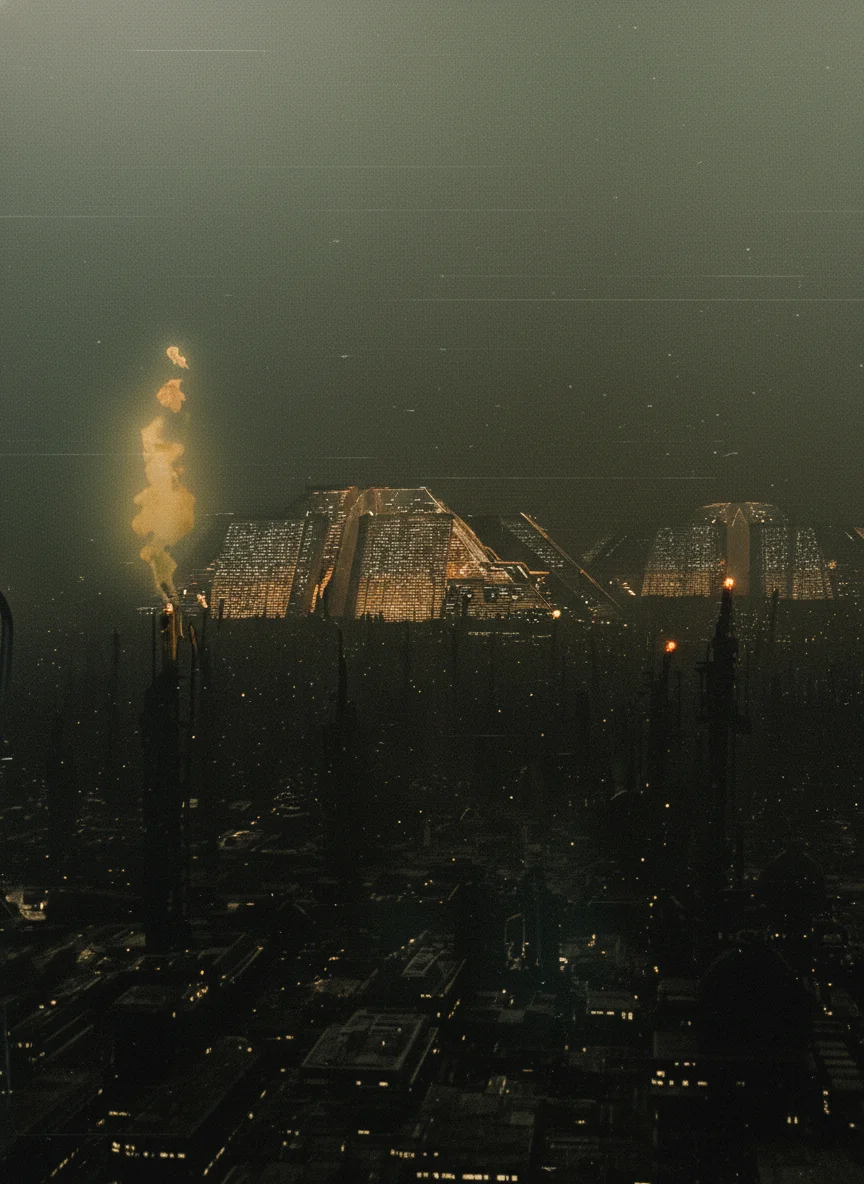
Blade Runner's Perpetual Night Fires

Ridley Scott (Director) (1982)

Los Angeles 2019 in Blade Runner (1982) burns with artificial light—flames from industrial stacks, neon reflecting off rain-slicked streets, the Voight-Kampff machine's red eye glowing. Natural sunlight never appears; every photon manufactured, every illumination clinging to its fuel source. Fire doesn't exist independently—it requires petroleum towers, electric grid, neon gas. The replicants are fire clinging to form: brilliant, intense, dependent on four-year lifespans, desperate to keep burning. Fire doubled—the Clinging repeated. A yin line embraced by yang, twice over.

Historical Context

Period
Zhou Dynasty
Oracle Bone Etymology
In oracle bone script, 離 depicted a bird (perhaps a pheasant) near a net or trap, suggesting something beautiful but dependent, something that must cling to survive.
Traditional Use
By Zhou times, the character came to represent fire's essential nature: it cannot exist alone but must cling to what it consumes.

Lines

Line 1: 履錯然敬之無咎

taking steps; tread, walking; conduct
cuòmixed up, confused; random; side, cross-
ránbut so, seemingly; -ly; ways; wise
jìngto respect, regard, honor, attending
zhīfor, to oneself, this, that; results, outcomes
and no; avoids; no is done
jiùblame; mistake, errors; harm

Line 2: 黃離元吉

huánggolden, harvest gold, yellow
radiance, arising, distinction, articulation
yuánmost, supremely, extremely
promising, fortunate, auspicious

Line 3: 日昃之離不鼓缶而歌則大耋之嗟凶

the sun, day
declines, goes down; after noon, in decline
zhīin, with, has its; approaches, comes to
radiance, arising; departure, separation
not; there is no; instead of, rather than
drumming, beating, banging on, upon
fǒuclay, earthenware pots, vessels
érand, while
singing
leads to; as a result, in due order; due to
much, a lot of; very; great, ripe, old
diéold age, the elderly 70-80 years; infirmity
zhī's; and its
jiēlament, complaint, sigh, groan, moaning
xiōngunfortunate, sad, disappointing, bad luck

Line 4: 突如其來如焚如死如棄如

sudden, abruptly; surprise, breakthrough
so, quite, how; such, what a
one's, this, such a, an
láiarrival, emergence; arise, appear, coming
seems; appears
féna ablaze, aflame, on fire; burning
so, quite, how; such, what a
mortal, perishable; mortality, death, ending
so, quite, how; such, what a, an
soon forgotten, cast aside, waste, discard
so, quite, how; such, what a

Line 5: 出涕沱若戚嗟若吉

chūissuing, pouring out, discharging, gushing
tears
tuórunning water; streaming, flowing water
ruòlike, as
grief; grievous, pitiful
jiēand lament; and sad
ruòsuch, what; how, so
promising, lucky, auspicious; good fortune

Line 6: 王用出征有嘉折首獲匪其醜無咎

wánga, the sovereign, king, ruler
yònguses, utilizes; makes use, takes advantage of
chūissues, outcomes, emergencies, uprisings
zhēngto expedite; advance, go boldly forward
yǒuthere are, will be; abundant, plentiful
jiācommendations, awards, credit where due
zhéand severed; and broken, the breaking of
shǒuheads; leaders
huòthe captives, captured, prisoners
fěiare not; never were; were never
of, in this, such; his
chǒucategory, class, sort; disgrace; enemies
no; not; nothing; without, with no
jiùblame; wrong; a mistake, an error

Practical Guidance

You're burning bright, but what are you clinging to? Your intensity is real. The question is: is it sustainable? Fire that clings to the right fuel—dry wood, purpose, disciplined practice—can burn for years. Fire that clings to volatile material—ego, desperation, unsustainable pace—flares brilliantly and dies. Check your fuel source. Replicants cling violently because they fear death. Roy Batty's final monologue—'I've seen things you people wouldn't believe'—is fire acknowledging it's about to go out. The intensity of that speech derives from its precarity. Four-year lifespan, enhanced abilities, no renewal. He clung to being alive so desperately that the clinging itself became destructive. Here's what 'care of the cow' means: gentle, consistent maintenance versus dramatic intervention. Cows are docile, productive, require regular feeding. The fire that lasts is the one tended daily, not the one that consumes everything available and then starves. This maps directly to sustained creative work. The developer who ships consistently for a decade versus the one who crunches dramatically for six months and burns out. The writer who produces 500 words daily versus the one who writes 10,000 in a weekend and then can't look at the manuscript for weeks. Fire must cling to something. Choose substrate that can sustain the burn. Blade Runner's Los Angeles burns with petrochemical fire—industrial, toxic, unsustainable. The film's visual language keeps showing flame and knowing it can't last. Deckard's world is running on resources it's exhausting. The replicants are products of this same system: brilliant, intense, disposable. The doubled fire hexagram has a yin line in the center—something soft, receptive, nourishing at the core. This is the fuel. If your core is rigid (all yang, no give), the fire can't cling properly. If your core is all yielding (all yin, no structure), the fire dissipates. What are you actually clinging to? Not what you say your values are—what you're actually burning. Track your energy expenditure for a week. What activities leave you energized (sustainable fuel) versus depleted (consuming yourself)? Fire clinging to itself just creates ash.

Get an interactive reading with this hexagram

Try the Oracle →