Hexagram 25: 無妄
wú wàng —without pretense, without presumption, without falseness
By Augustin Chan · Last updated 2025
Judgment
Innocence. Supreme success. Perseverance furthers. If one is not as one should be, there is misfortune.
Image
Under heaven, thunder rolls: the image of Innocence. Thus the superior person enriches their character and acts without ulterior motive.
Cellular Automaton
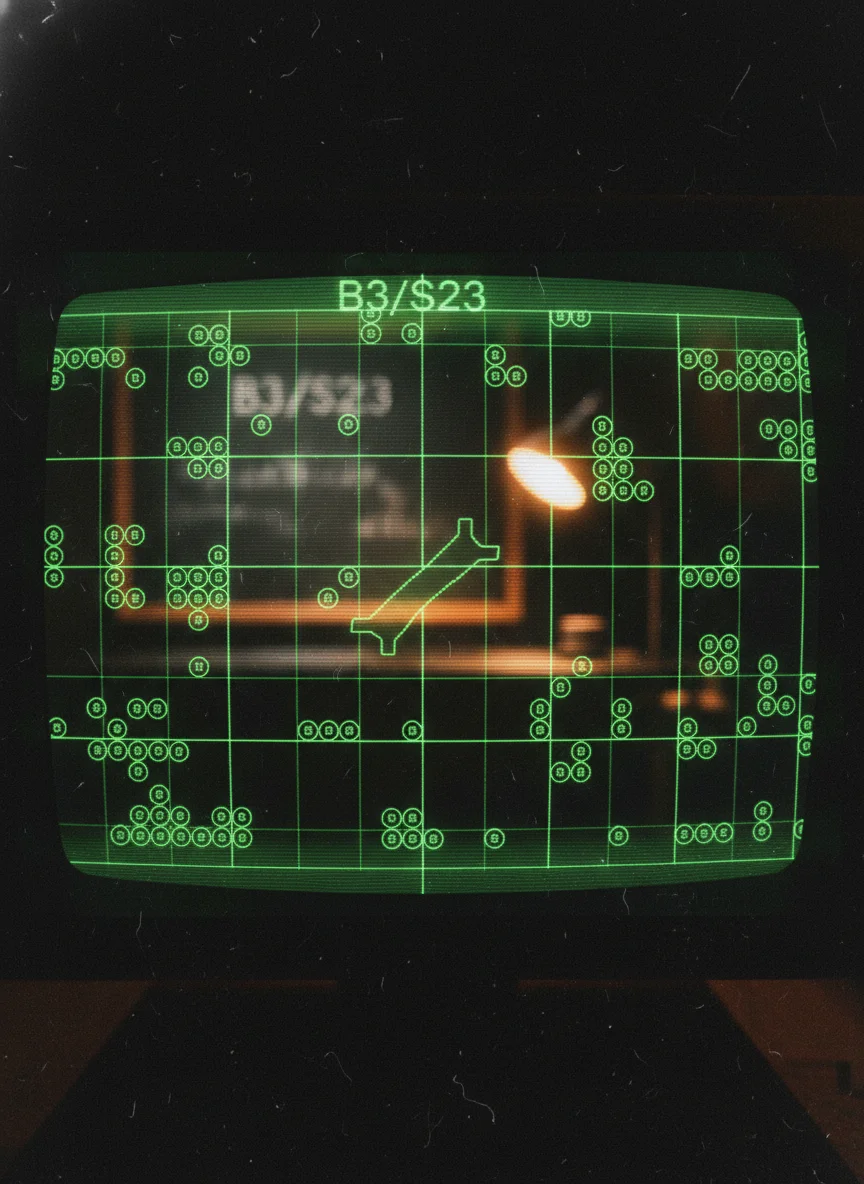
Conway’s Game of Life — First Glider
John H. Conway (Bell Labs / Mathematical folklore) (AD 1970)
Five pixels, three rules, and then—movement with no pilot. In the Game of Life, a tiny pattern called a "glider" discovers locomotion without intention. This is 無妄: action arising from law, not from schemes. No plot, no hidden agenda—just the universe doing what it does when constraints are clean. When the board is honest, life moves on its own. Interfere for cleverness and you kill it; set the rules true and you get surprise—supreme success—without trying.
Historical Context
- Period
- Zhou Dynasty
- Oracle Bone Etymology
- Heaven (☰) above, Thunder (☳) below—creative principle presiding over spontaneous arousal.
- Traditional Use
- Innocence = the unexpected that accords with natural order. Do what is correct; let outcomes emerge. Calculated guile brings misfortune.
- Character Analysis
- The glider embodies movement unpremeditated: simple lawful conditions produce emergent motion. It’s not naivety; it’s freedom from contrivance.
- Energy State
- Creative clarity above guiding spontaneous motion below.
- Trigram Symbolism
- ☰ Heaven (Upper) — Creative order ☳ Thunder (Lower) — Sudden movement Movement that follows first principles, not manipulation.
Lines
Line 1: 無妄往吉
Line 2: 不耕穫不菑畬則利有攸往
Line 3: 無妄之災或繫之牛行人之得邑人之災
Line 4: 可貞無咎
Line 5: 無妄之疾勿藥有喜
Line 6: 無妄行有眚無攸利
Practical Guidance
Transformations
When changing lines appear in a reading, this hexagram can transform into another.
Get an interactive reading with this hexagram
Try the Oracle →