Judgment
The Power of the Great. Perseverance furthers. But the goat butts against the hedge and gets his horns entangled. Great power requires corresponding great character. When strength exceeds wisdom, even the strong come to grief.
Image
Thunder in the heavens above: the image of the Power of the Great. Thus the superior man does not tread upon paths that do not accord with established order. The danger is not the power itself but power exercised without restraint or ethical foundation.
Anime Prophecy
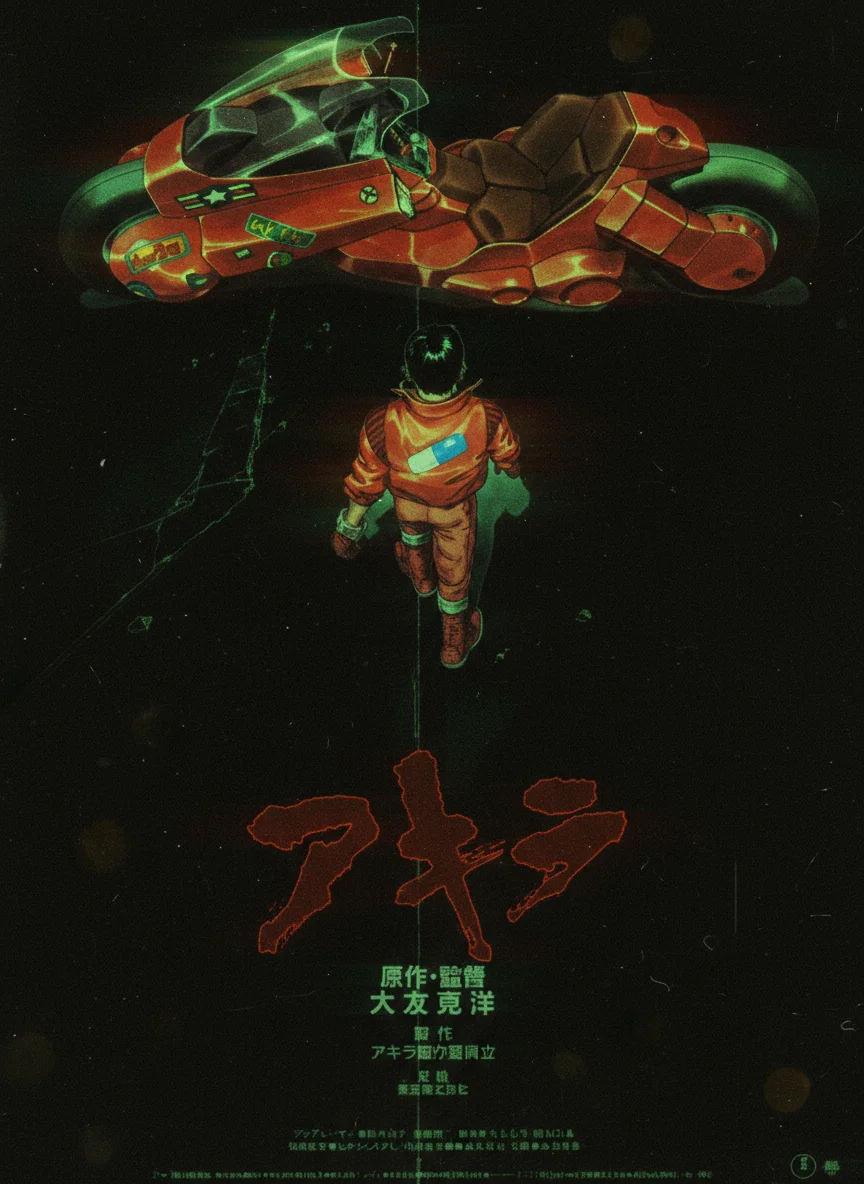
Akira
Katsuhiro Otomo (1988)
Neo-Tokyo, 2019, Katsuhiro Otomo's 1988 masterwork. Thirty-one years after the original Tokyo was destroyed by psychic explosion, teenage biker Tetsuo Shima—bullied nobody—crashes his motorcycle and awakens god-tier abilities: telekinesis, matter manipulation, forces that tear through military installations and Olympic Stadium. Thunder over Heaven—movement energized by fundamental creative force, power accumulating without restraint. But Tetsuo has no wisdom to match the magnitude. His body mutates grotesquely, flesh expanding, organs growing chaotically, becoming a bloated screaming mass of uncontrolled cellular growth. The goat butting against the hedge, horns entangled. Contrast Kaneda on his iconic red motorcycle—same Thunder energy, but channeled through skill, the power slide executed with perfect control. Mechanical force mastered, aesthetically beautiful. The hexagram's warning made visceral: when teenagers receive abilities they're unprepared for, when power catastrophically exceeds character, apocalypse. Neo-Tokyo burns again. Great strength without corresponding wisdom devours itself.
Historical Context
- Period
- Zhou Dynasty
- Oracle Bone Etymology
- Thunder (☳) above, Heaven (☰) below—the Arousing mounted on the Creative. Movement energized by fundamental power.
- Traditional Use
- Wilhelm describes this as 'the power of the great' when inner worth mounts with great force. But strength that passes the median line becomes dangerous—reliance on power alone, forgetting to ask what is right.
- Character Analysis
- Tetsuo embodies the hexagram's warning perfectly: immense capability, zero restraint, no ethical foundation. Kaneda demonstrates the alternative: power combined with control, force directed through skill. The contrast between controlled Thunder (motorcycle slide) and uncontrolled Thunder (psychic explosion).
- Energy State
- Four strong yang lines rising through lower positions, enormous force accumulating and pushing upward. Read bottom to top: creative power below generating movement above, but excess strength becomes its own obstacle.
- Trigram Symbolism
- ☳ Thunder (Upper) - Shock, arousal, explosive movement ☰ Heaven (Lower) - Creative force, primal power, fundamental energy Thunder over Heaven: psychic awakening from cosmic source.
Sources
Lines
Line 1: 壯于趾征凶有孚
Line 2: 貞吉
Line 3: 小人用壯君子用罔貞厲羝羊觸藩羸其角
Line 4: 貞吉悔亡藩決不羸壯于大輿之輹
Line 5: 喪羊于易無悔
Line 6: 羝羊觸藩不能退不能遂無攸利艱則吉
Practical Guidance
Transformations
When changing lines appear in a reading, this hexagram can transform into another.
Get an interactive reading with this hexagram
Try the Oracle →