Judgment
Contemplation. The ablution has been made, but not yet the offering. Full of trust they look up to him. The sacred pause between preparation and action—when observation itself becomes transformative, when watchers become teachers.
Image
The wind blows over the earth: the image of Contemplation. Thus the ancient kings visited the regions of the world, contemplated the people, and gave them instruction. The CEO who reads user feedback, the astronaut who photographs Earth—observation that transforms into teaching.
Photographic Perspective Shift
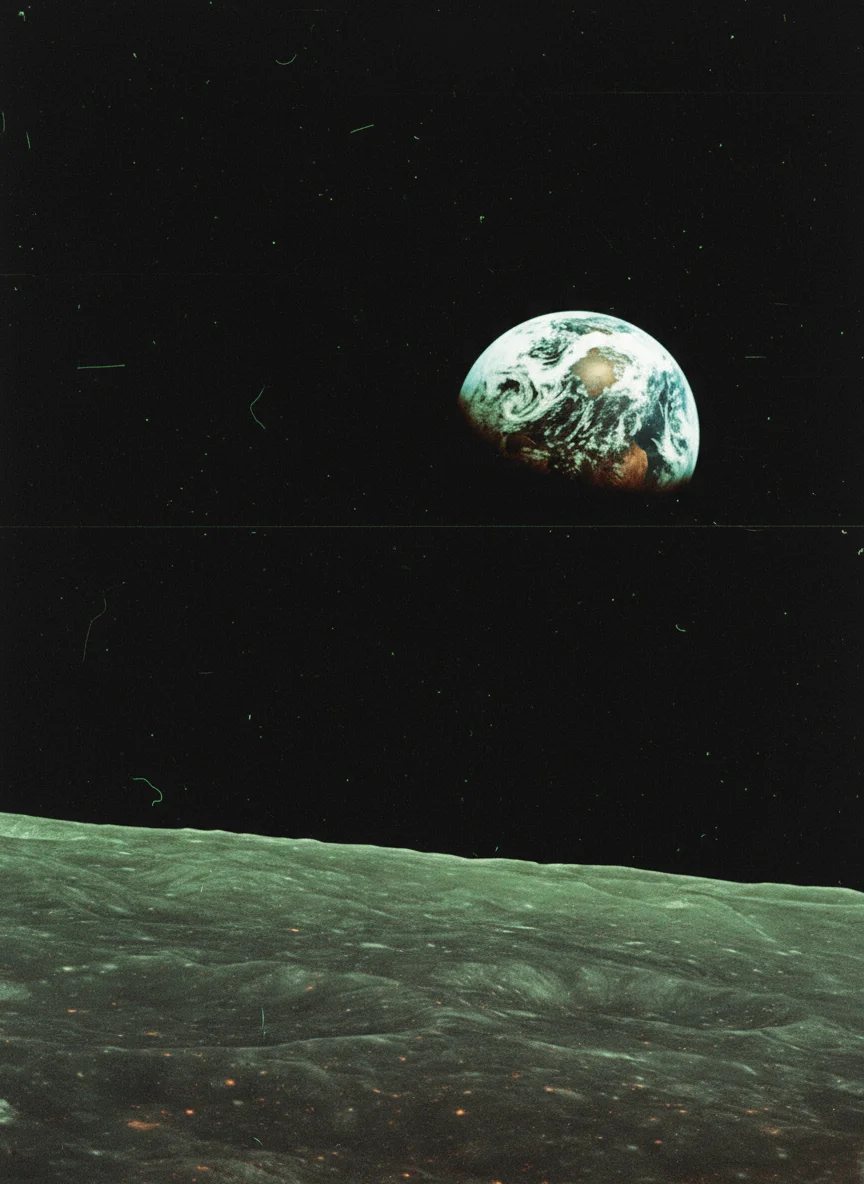
Earthrise — Apollo 8, Lunar Orbit, Christmas Eve 1968
William Anders, Frank Borman, Jim Lovell (1968)
December 24, 1968, lunar orbit: Apollo 8 comes around the dark side of the moon. William Anders looks out the window. Earth—brilliant blue, cloud-swirled, rising above grey lunar desolation. "Oh my God, look at that picture over there!" Anders grabs the Hasselblad. Borman: "Hey, don't take that, it's not scheduled." Anders: "Hand me a color film, quick." He takes the shot. This is guan (觀) made visible: contemplation. Wind above Earth—the spacecraft observes while being observed. Three astronauts watch Earth; Earth watches them. The image becomes example. Anders later: "We came all this way to explore the moon, and the most important thing is that we discovered the Earth." The classical text says: contemplation both as viewing and being an example. Apollo 8's mission was lunar reconnaissance. Its achievement was perspective. That photo—Earthrise—did more than any speech to shift human consciousness. It launched the environmental movement, made borders look absurd, rendered nationalist rhetoric small. Borman read from Genesis on live broadcast: "In the beginning..." But what they really transmitted was the view from the tower—elevated perspective showing the connected whole.
Historical Context
- Period
- Zhou Dynasty
- Oracle Bone Etymology
- Wind (☴) above, Earth (☷) below—wind blows over the earth, touching everything, changing everything.
- Traditional Use
- Guan means contemplation, observation, watching from elevated vantage point. The text describes the moment between ritual purification and offering—deepest concentration before action. Ancient Chinese towers served double purpose: observation post (looking out) and landmark (being seen from afar).
- Character Analysis
- 觀 (guān) - to observe, to contemplate, to be an example. Apollo 8 embodies both meanings: the astronauts observe Earth from lunar orbit, while simultaneously serving as examples of human capability and perspective-taking. They are watchers and watched.
- Energy State
- Observation from proper distance, influence through elevated perspective. Read bottom to top: earth's receptivity below (lines 1-2 yang, line 3 yin), wind's penetrating movement above (all yin). The strong foundation supports contemplative vantage.
- Trigram Symbolism
- ☴ Wind (Upper) — The Gentle, penetrating, far-reaching influence ☷ Earth (Lower) — The Receptive, grounded, all-supporting Wind moves over earth—invisible force touching everything, changing perspective through gentle, persistent influence.
Sources
Lines
Line 1: 童觀小人無咎君子吝
Line 2: 闚觀利女貞
Line 3: 觀我生進退
Line 4: 觀國之光利用賓于王
Line 5: 觀我生君子無咎
Line 6: 觀其生君子無咎
Practical Guidance
Transformations
When changing lines appear in a reading, this hexagram can transform into another.
Get an interactive reading with this hexagram
Try the Oracle →