Judgment
The Receptive brings about sublime success, furthering through the perseverance of a mare. The mare doesn't lead the herd through aggression but through steady, grounded movement—just as memory storage doesn't flash and spark like active CPU cores but faithfully preserves what's entrusted to it.
Image
The earth's condition is receptive devotion. Thus the superior man of broad character carries the outer world. Six broken lines create maximum capacity, the ability to hold vast complexity without imposing structure prematurely.
Digital Artifact
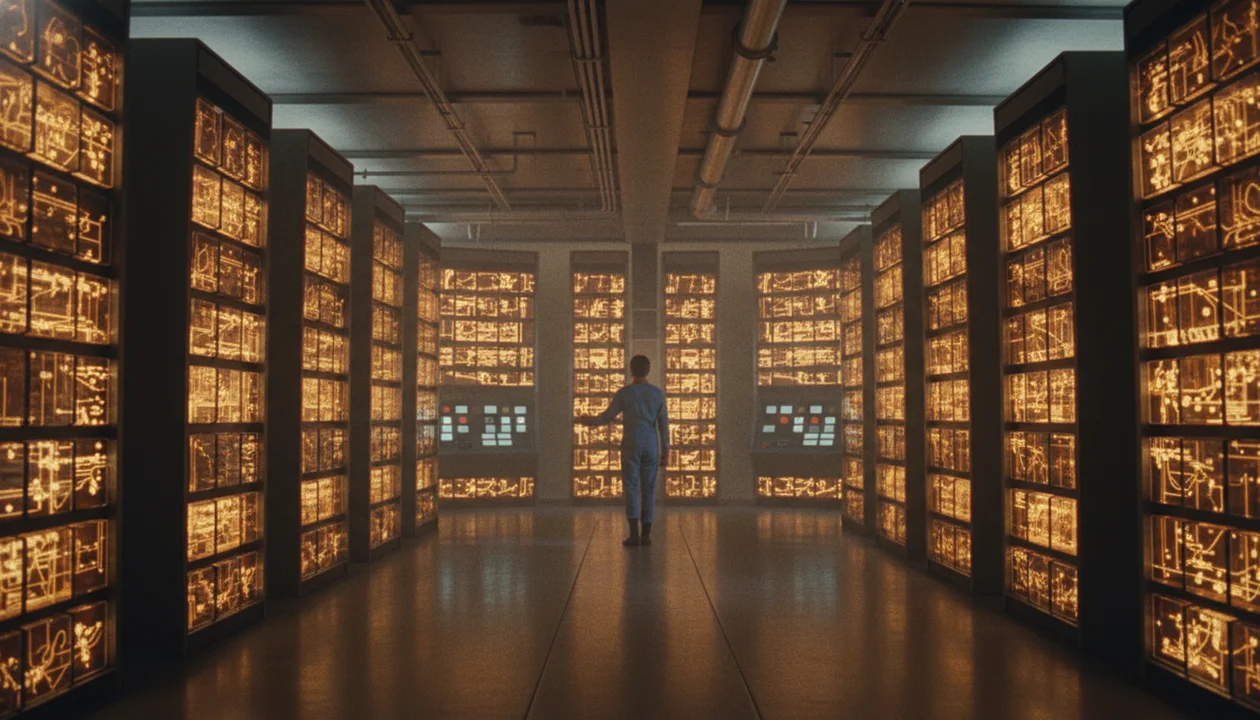
HAL 9000's Memory Banks
Stanley Kubrick (Director), 2001: A Space Odyssey (1968)
In Discovery One's "logic memory center," HAL 9000's memory banks fill an entire room—row upon row of translucent blocks glowing from within. When Dave Bowman begins the shutdown in Kubrick's 2001 (1968), we witness consciousness stored: every thought, calculation, song HAL learned, preserved in amber light. This isn't active processing—it's pure receptivity. The memory core doesn't initiate; it receives, contains, yields data only when accessed. Six broken lines creating space for holding complexity. The soft amber glow suggests warmth, not the aggressive green of active computation.
Historical Context
- Period
- Han Dynasty commentators emphasized interpretation
- Oracle Bone Etymology
- In oracle bone script, 坤 originally depicted earth or soil, representing the yin principle's capacity to receive seeds, nurture growth, and bring form to formless energy.
- Traditional Use
- Han Dynasty commentators emphasized that Kun doesn't create independently but makes creation possible by providing ground, space, containment.
- Character Analysis
- The character 坤 (Kūn) represents pure yin receptivity—earth receiving seeds, storage capacity, the ground that makes creation possible.
- Energy State
- Pure yin receptivity, maximum containing capacity. Six broken lines create space for holding complexity.
- Trigram Symbolism
- ☷ Earth (Upper) - Receptive Ground, Mother, Earth ☷ Earth (Lower) - Receptive Ground, Mother, Earth Earth doubled: the earth's condition is receptive devotion.
Sources
Lines
Line 1: 履霜堅冰至
Line 2: 直方大不習無不利
Line 3: 含章可貞或從王事無成有終
Line 4: 括囊無咎無譽
Line 5: 黃裳元吉
Line 6: 龍戰于野其血玄黃
Practical Guidance
Transformations
When changing lines appear in a reading, this hexagram can transform into another.
Get an interactive reading with this hexagram
Try the Oracle →