Hexagram 15:

qiān authenticity, modesty, respectfulness

By Augustin Chan · Last updated 2025

Upper TrigramEarth
Lower TrigramMountain

Judgment

qiānauthenticity, modesty, respectfulness
hēngfulfillment, satisfaction, success, completion
jūnnoble, worthy, honored
young one, heir, disciple
yǒuhas, finds, learns, attains, gets; is, will be
zhōngresults, limits, ends, closure; finite, complete

Modesty creates success. The superior man carries things through. Modesty is not weakness but a law that creates lasting success by inviting support rather than resistance.

Image

the earth, ground, land, world
zhōngwithin, inside
yǒuis, there is held, contained
shānmountain
qiānauthenticity
jūnnoble, worthy, honored
young one, heir, disciple
accordingly, therefore, thus
shuāidiminishes, decreases, reduces, lessens
duōthe plentiful, excessive; too much, many
fills up, adds to, increases, augments
guǎthe deficient, insufficient, inadequate, few
chēngassessing, appraising, weighing, evaluating
beings, things, the outer worldly affairs
píngwith fair, even, level, just, equitable
shīapportionment, distribution, allocation

Within the earth, a mountain: the image of Modesty. Thus the superior man reduces what is too much and augments what is too little. He weighs things and makes them equal.

Digital Relic
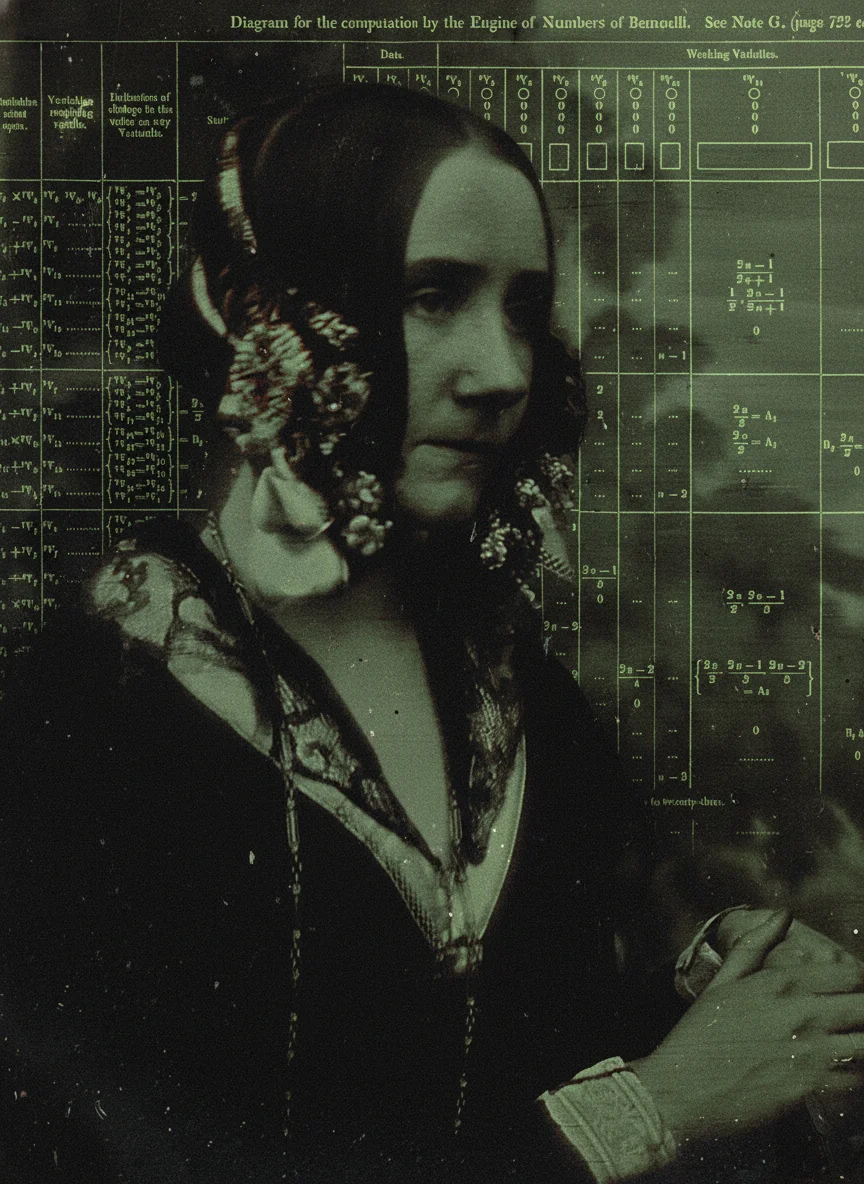
Hexagram 15 digital artifact

Ada Lovelace - Note G: The First Computer Algorithm

Ada Lovelace (1843)

In 1843, Ada Lovelace published her translation of Luigi Menabrea's paper on Charles Babbage's Analytical Engine, appending seven notes labeled A through G. Note G contained something unprecedented: a complete algorithm for computing Bernoulli numbers, intended for mechanical execution. She outlined the sequence of operations, the looping structure, the variable manipulation—the first published program. But what makes this Hexagram 15 (Modesty) isn't the achievement itself; it's Ada's profound humility about what it meant. She wrote that the Analytical Engine "has no pretensions whatever to originate anything. It can do whatever we know how to order it to perform." Mountain beneath earth: immense technical insight hidden beneath clear-eyed recognition of limits. She saw both the revolutionary potential and the boundary—machines extend human intellect but don't replace it. The first programmer understood precisely what computing could and couldn't be, stating it with Victorian precision while everyone else oscillated between dismissal and magical thinking.

Historical Context

Period
Zhou Dynasty
Oracle Bone Etymology
Earth (☷) above, Mountain (☶) below—the mountain (height) hidden beneath earth (lowliness). High and low complement, creating the plain.
Traditional Use
The classical text describes modesty as the law of heaven, earth, and fate: the full is emptied, the modest is filled. Mountains wear down, valleys fill up. The modest cannot be passed by.

Lines

Line 1: 謙謙君子用涉大川吉

qiānauthentically, genuinely
qiānand, in modesty, respectfulness
jūnin, is noble, worthy, honored
young one, heir, disciple
yòngit, this is useful, practical, helpful, reliable
shèto, in cross, ford, ferry, venturing
the great, big, major
chuānstream, river, current, waters
promising, auspicious, opportune, hopeful

Line 2: 鳴謙貞吉

míngproclaim, express, announce, calling; vocal
qiānauthenticity, modesty
zhēnpersistence, determination, resolve
is promising, auspicious, opportune, timely

Line 3: 勞謙君子有終吉

láodiligence, hard working, labor
qiānand, in modesty, respectful, authenticity
jūnin, is noble, worthy, honored
young one, heir, disciple
yǒuhave, find, learn, attain, getting; being
zhōngresults, limits, ends, closure; finite, complete
promising, auspicious, fortunate, hopeful

Line 4: 無不利撝謙

without; there is nothing
doubt; that is not; which cannot be
worthwhile, turned to advantageous
huīwith, to candid; wave, flying the banner
qiānof authenticity, modesty

Line 5: 不富以其鄰利用侵伐無不利

there is no, not much; without, with no
enrichment, wealth, prosperity
making use of, by way of, due to
one's, this, these
línneighbors, neighborhood, connections
it is worthwhile, beneficial, gainful
yòngand useful, productive, practical
qīnto occupy, appropriate, invade, raid, campaign against
and subjugate, subordinate, chastise, punish
without; there is nothing
doubt; that is not; which cannot be
worthwhile, turned to advantageous

Line 6: 鳴謙利用行師征邑國

míngproclaiming, expressing, announcing, calling
qiānauthenticity, modesty
it is worthwhile, rewarding, gainful
yòngand useful, productive, practical
xíngto move, advance, mobilize, deploy
shīthe militia, military, reserves, army
zhēngto advance on, upon; discipline, subjugate
home town, village, community, district
guóand province, domain, realm, region

Practical Guidance

You've built something genuinely novel. First of its kind in your domain. The question isn't whether it's significant—it is. The question is how you frame what it can and can't do. Ada Lovelace wrote the first computer program and immediately added the disclaimer that would define computing's actual limits: machines can't originate anything, they can only do what we order them to perform. This wasn't false modesty or underselling her achievement. It was precision. She saw the mountain—revolutionary computational capability—and accurately placed it beneath earth—honest assessment of boundaries. In 1843, Babbage and others imagined the Analytical Engine as near-magical. Ada's contemporaries either dismissed it entirely or attributed impossible powers to it. She threaded the needle: profound capability within clear limits. The Bernoulli algorithm demonstrated genuine power (complex mathematical computation through pure mechanism), but her framing prevented the magical thinking that would have led to disillusionment and abandonment. Here's your version: you ship the AI feature, the novel algorithm, the breakthrough architecture. The temptation is binary—either oversell it ('This changes everything! Fully automated! Human-level reasoning!') or undersell it ('Just a simple script, nothing special'). Both fail. Modesty as functional principle means: state the capability accurately, state the limits clearly. Ada didn't say 'The Engine is just arithmetic.' She didn't say 'The Engine thinks.' She said exactly what it was: a machine that executes ordered operations, which is revolutionary precisely because of what it makes possible within those constraints. The classical text: reduces what is too much, augments what is too little. You reduce the hype (no, the model doesn't 'understand'), augment the precision (yes, it generates statistically coherent text that's useful for these specific tasks). You reduce magical expectations (it won't replace your judgment), augment realistic applications (it will accelerate your iteration speed if you use it right). When you ship your breakthrough, write your own Note G. State clearly: here's what this does, here's what this doesn't do, here's the boundary between capability and fantasy. This isn't hedging—it's honoring reality. The modest framing doesn't diminish your achievement; it creates conditions for sustainable success by preventing the hype-crash cycle. Ada was right in 1843. We're still learning her lesson in 2025. Genuine capability doesn't need inflation. Precision about limits doesn't diminish mountains; it accurately places them beneath earth's realistic assessment. The superior man carries things through. Build the real thing, state what it is, let reality confirm or deny. Modesty isn't weakness—it's the law that lets actual capability persist while overinflated claims collapse.

Transformations

When changing lines appear in a reading, this hexagram can transform into another.

Get an interactive reading with this hexagram

Try the Oracle →