Judgment
Standstill. Evil people do not further the perseverance of the superior man. The great departs; the small approaches. Heaven and earth do not unite, and all beings fail to achieve union.
Image
Heaven and earth do not unite: the image of Standstill. Thus the superior man falls back upon his inner worth in order to escape the difficulties. He does not permit himself to be honored with revenue.
Psychohistorical Archive
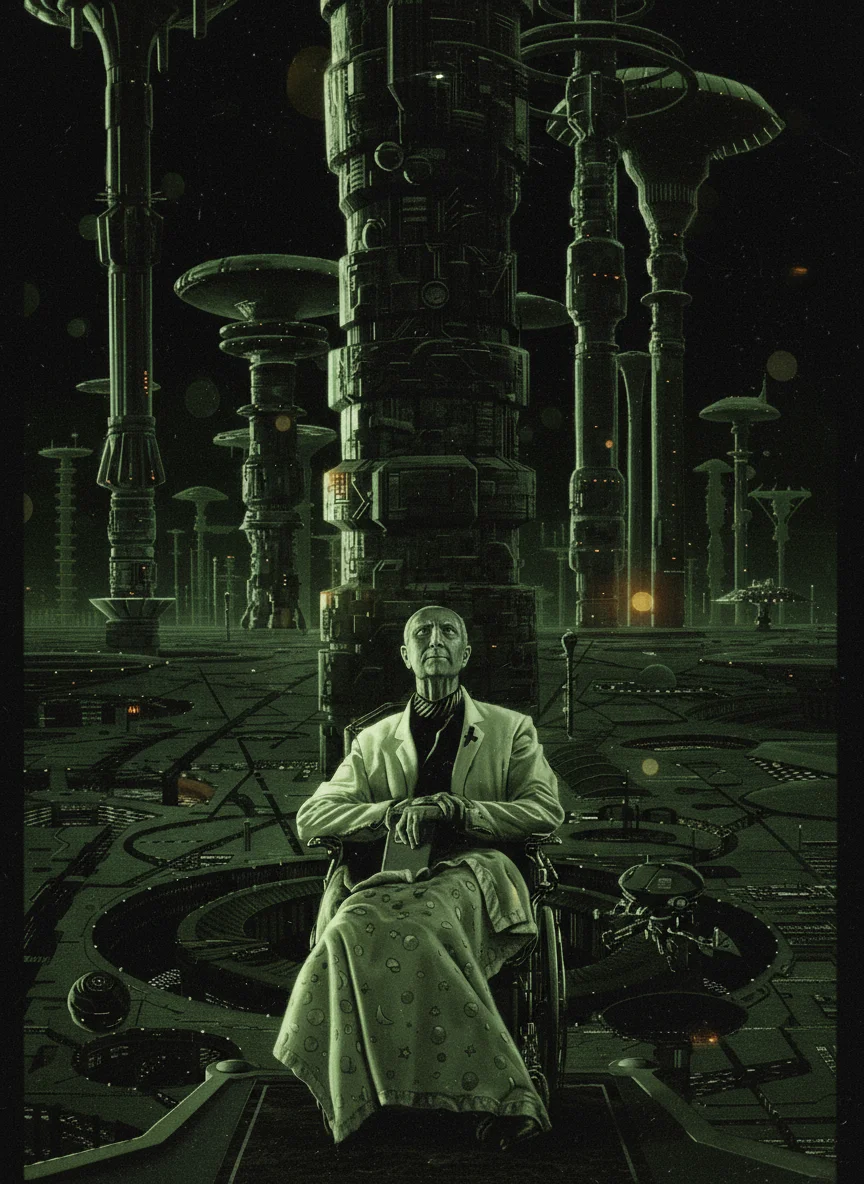
Foundation - The Galactic Empire's Terminal Stagnation
Isaac Asimov (1951)
Hari Seldon stands before the Commission of Public Safety in 12,020 G.E., presenting mathematical proof that the Galactic Empire will fall within three centuries. Twelve thousand years of civilization, 25 million inhabited worlds, all entering terminal decline—not through invasion or catastrophe, but through accumulated stagnation. The imperial bureaucracy has ossified. Innovation has ceased. The creative forces that built the Empire and the receptive forces that sustained it no longer communicate. Heaven and Earth drawing apart. The Commission sentences Seldon to exile on Terminus, dismissing psychohistory as malicious speculation, but their very reaction confirms the diagnosis: a system so rigid it can't even hear warnings of its own collapse. The mathematics are irrefutable—30,000 years of darkness approaching, interstellar travel forgotten, science reduced to religious ritual, trillions dying in the chaos. Seldon's Plan can shorten the dark age to 1,000 years, but it can't prevent the standstill from running its course. The Empire must fall. The only question is what survives to rebuild afterward.
Historical Context
- Period
- Zhou Dynasty
- Oracle Bone Etymology
- Heaven (☰) above, Earth (☷) below—proper positions but pulling apart, no communication between creative and receptive forces.
- Traditional Use
- Wilhelm describes standstill as heaven and earth losing communion. The great departs (people of vision withdraw), the small approaches (bureaucrats ascend). Not evil people winning but the system itself unable to support greatness.
- Character Analysis
- The character 否 (pǐ) combines 'not' with 'mouth'—inability to communicate, blockage. Heaven above wants to ascend, Earth below wants to descend. No exchange occurs. Foundation captures this: Empire's knowledge degrading into ritual, leadership unable to hear warnings, creative and receptive forces severed.
- Energy State
- Heaven and Earth in proper positions but pulling apart. Creative force withdraws upward, receptive force sinks downward. No communion, no exchange—standstill.
- Trigram Symbolism
- ☰ Heaven (Upper) - The Creative, retreating upward ☷ Earth (Lower) - The Receptive, sinking downward Proper positions, but they do not communicate with each other.
Sources
Lines
Line 1: 拔茅茹以其彙貞吉亨
Line 2: 包承小人吉大人否亨
Line 3: 包羞
Line 4: 有命無咎疇離祉
Line 5: 休否大人吉其亡其亡繫于苞桑
Line 6: 傾否先否後喜
Practical Guidance
Transformations
When changing lines appear in a reading, this hexagram can transform into another.
Get an interactive reading with this hexagram
Try the Oracle →