Judgment
Youthful Folly has success. It is not I who seek the young fool; the young fool seeks me. At the first oracle I inform him. If he asks two or three times, it is importunity. If he importunes, I give him no information. Perseverance furthers.
Image
A spring wells up at the foot of the mountain: the image of Youth. Thus the superior man fosters his character by thoroughness in all that he does.
Historical Assassination
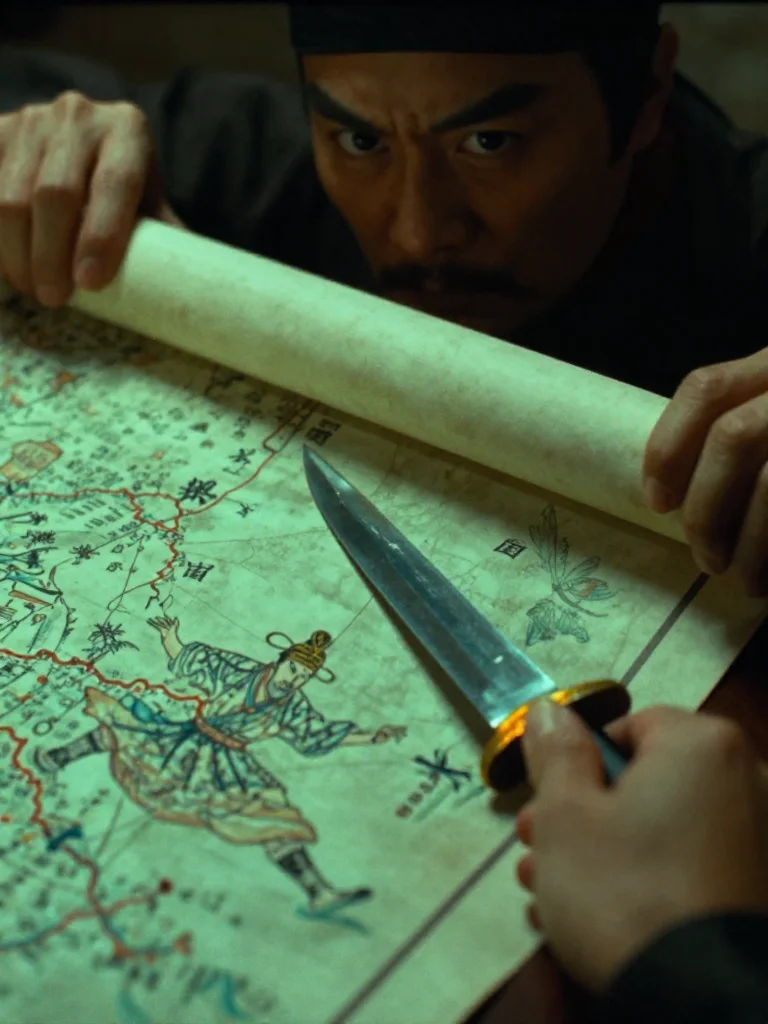
Jing Ke's Dagger in the Map
Jing Ke 荊軻 (227 BC)
227 BC. The Qin palace. An assassin from Yan unrolls a map before the King of Qin—a map showing territories his state will cede. Hidden inside: a poisoned dagger. The phrase for this moment: 圖窮匕見 (túqióng bǐxiàn)—'when the map is unrolled, the dagger is revealed.' Jing Ke grabbed the king's sleeve and lunged. The sleeve tore. The king fled, circling pillars, struggling to draw a ceremonial sword too long for combat. A physician threw his medicine bag to slow the assassin. Finally the king drew from behind his back, struck Jing Ke's thigh, then stabbed him eight more times. Dying, Jing Ke sat with legs spread—a deliberate insult—and taunted his target. According to the Shiji, before departing, he had sung at the Yi River: '風蕭蕭兮易水寒,壯士一去兮不復還'—'The wind howls, the Yi River is cold; a brave man once departed will never return.' He knew. He went anyway. This is 蒙 (Méng): not stupidity, but the folly of youth against systems. One dagger cannot stop unification. The attempt accelerated Yan's destruction.
Historical Context
- Period
- Zhou Dynasty
- Oracle Bone Etymology
- Mountain (☶) sits above, Water (☵) flows below—the spring at the mountain's foot, unclear but seeking.
- Traditional Use
- Youthful Folly (蒙) describes the mountain spring—water emerging from darkness, not yet clear. Wilhelm: 'The hexagram pictures a state of youthful folly. A young fool seeks the master, not the master the young fool.' The student must come with questions; wisdom cannot be forced upon the unwilling.
- Character Analysis
- The character 蒙 (méng) depicts a cover or veil—vegetation obscuring vision. It means 'covered,' 'ignorant,' 'naive.' Not pejorative: the spring will eventually run clear. The state is temporary. But the question is whether the naive act before or after clarity arrives.
- Energy State
- Water springs from beneath the mountain—energy emerging from stillness, seeking but not yet finding its course. The mountain above suggests obstruction; the water below suggests potential. The combination: nascent force meeting immovable structure.
- Trigram Symbolism
- ☶ Mountain (Upper) - Stillness, obstruction, immovability ☵ Water (Lower) - Danger, flow, the abysmal Water at the mountain's base—either it finds a channel or pools against the rock. The image of youth confronting systems larger than itself.
Sources
- Jing Ke - Wikipedia
- Commemorating a Failed Assassin: The Making of the Jing Ke Lore in Early China - Cambridge Core
- The Contingency of China's Imperial Unity: Assassins Attack the First King of Qin - Association for Asian Studies
- Tao Yuanming: Chant For Jing Ke - LAC Poetry
- Analysis of a Classic Chinese Poem: 咏荆轲 - Hanzi Explorer
Lines
Line 1: 發蒙利用刑人用說桎梏以往吝
Line 2: 包蒙吉納婦吉子克家
Line 3: 勿用取女見金夫不有躬無攸利
Line 4: 困蒙吝
Line 5: 童蒙吉
Line 6: 擊蒙不利為寇利禦寇
Practical Guidance
Transformations
When changing lines appear in a reading, this hexagram can transform into another.
Get an interactive reading with this hexagram
Try the Oracle →